Boat Propellers, Custom Props,
Boat Propeller Repairs, Prop Reconditioning



3734 West State Highway 154
Yantis, TX 75497

Prop Repairs
We repair most makes and models and specializes in stainless
repairs and modifications.
Click
here for:
custom work sheet


Monday 8am-4pm
Tuesday-Friday 8am-5pm
Saturday 8am-12pm
Closed Sunday

Customer Comment:
"I'm in the boat repair
business and pride myself with the ability to set
a boat up correctly. However, there comes a point
where the boat needs more help to perform
correctly than just the boat being set up and
dialed in. Generally the only way to get that
little extra edge is to have your propeller
modified.
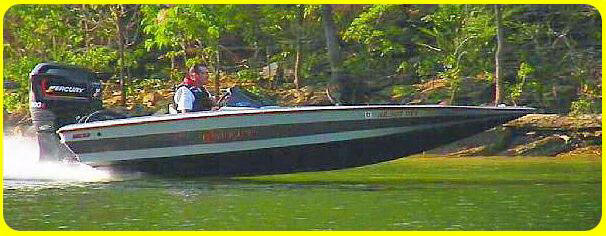
After re powering my Champion 203 with a Mercury
225 Pro XS, it was still not performing exactly as
it should. I tried eight or ten different props
and finally found which factory prop ran the best
overall.
I then sent the prop to Steve at Steve's Custom
Props. He immediately found that the one blade was
1/4 of a pitch off from the Factory! He then
customized the prop and put his magic touch to it.
All I can say is WOW. I got four to five more
miles per hour, the hole shot is the best it has
EVER been, and the midrange turning and handling
is completely different! The boat had good bow
lift before, but now it is incredible!
Having used many different Prop Shops over the
years. There was one thing that made Steve's work
stand apart. Most customers probably would not
even notice this, but when the prop came back, it
was polished and didn't have any grinding marks or
other blemishes that many of the other shops don't
take the time to correct. That impressed me as
much as the performance difference!
If you want one of the best in the business to
repair your prop, add more cup, or completely
customize your prop, Steve is the guy to call!
Michael Bristow
North Texas Fiberglass
Steve,
I just wanted to thank you for your help getting my new prop 'dialed
in' ! I finally got the boat out after our last conversation and my
zx200 got up to 68.5mph with a full tank and 15mph winds chopping up
the lake. A low tank and slight ripples and I'll be screaming!
Thanks again,
Shawn
Frequently Asked Questions
What is a balanced and blueprinted prop?
How do I adjust the prop shaft engine height?
What is a balanced and blueprinted prop?
At Steve’s Custom Props balance and blueprinting is offered on most bass boat propellers, including our new et cut choppers.
A balanced and blueprinted prop offers better hole shots and a reduction in vibrations, as well as increased fuel economy and enhanced top end performance.
Most new propellers manufactured today are not close enough in pitch tolerances, nor are they perfectly balanced and polished.
At Steve’s Custom Props your prop is placed on a pitch block and all blades are made to fit exactly in pitch and rake, then they are checked for accuracy on the pitch gauges. Then the propeller is perfectly balanced, and the leading edges thinned slightly for increased performance.
Then the propeller is finished in a very high polished finish.
Prices vary per application, give us a call for a price quote.
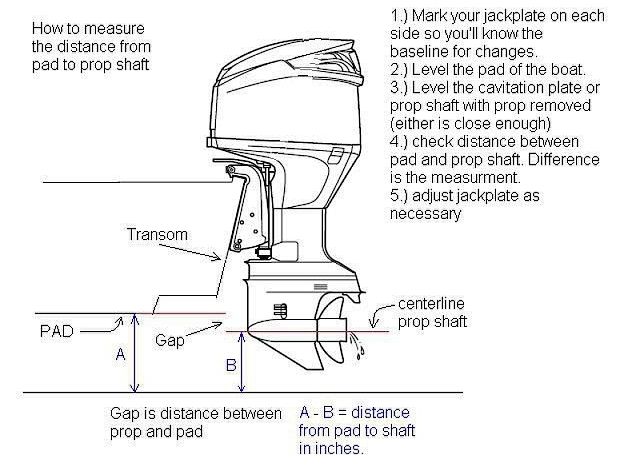
How do I adjust the prop shaft engine height?
1.) Level the boat. Place a level under the pad of the boat. Adjust the trailer jack up or down till boat is level
2.) Level the motor. Place the level on the cavitation's plate, and trim the engine down till it's level
3.) Measure from the ground to the pad, Write the measurement down
4.) Measure from the ground to the center of prop shaft, Write it down.
5.) Deduct the two measurements. You want the prop shaft 3 1/2" below the pad of the boat.
6.) Adjust the jack plate up or down, paying close attention the water pressure and max. engine rpms.
7.) On lighter hulls with low water pickups, running at a neutral trim angle is best. To find the neutral trim angle, simple turn the ignition key on when you have set the engine at level. The needle will be pointing to a neutral position. If needed mark the trim gauge for future reference.
How do I determine pitch?
The propeller
is the final
link in a
boat's power
train. Its job
is to take the
torque created
by a marine
engine and
convert this
torque to
forward
movement. A
propeller is
designed to
control the
engine's RPM
and hold it at
wide open
throttle to
the
recommended
RPM range
specified by
the
manufacturer
of a motor.
The power
curve is the
RPM range
where the
motor is
developing its
maximum
horsepower and
efficiently.
If the motor
revs beyond
this point, it
is over
revving, and
if the motor
is not able to
reach this
point it is
loaded down,
which could
have damaging
effects in the
internal
components of
the engine, as
well as allow
the engine to
use fuel
excessively.
Either way,
this causes
poor
performance
and
unnecessary
wear and
strain of the
drive train.
Propeller
pitch is
speed, however
there are also
several other
factors which
allow a boat
to perform to
it's
potential.
Such as, pitch
progression,
rake, and
cupping. Also
the gear ratio
of the lower
unit is also
extremely
important to a
boats
potential for
speed.
Why composite hubs systems?
Composite hubs
are engineered
to provide
fail safe
points. This
provides more
cushion when
shifting and
the hub is
engineered to
fail before
any drive
train damage
occurs.
Composite hubs
are field
replaceable.
Just knock out
the old sleeve
and put in a
new one. No
technical
skills or
tools are
needed.
Composite hubs
allow you to
limp home
after impact
and your drive
train has a
much better
chance of
survival
without any
internal
damage.
Composite hubs
are engineered
to withstand
high
temperatures
and will not
degrade when
exposed to
high exhaust
temperatures,
this is a
common problem
with rubber
hubs on high
horsepower
engines.
Composite hub
propellers are
extremely
versatile.
Replacements
are made for
all engine
types. By
simply
replacing the
thrust washer
and driver
adapter, you
can install
the same
propeller on
virtually any
engine.
Rubber hub
propellers are
limited to one
specific
application.
Replacements
for rubber
hubs are much
more expensive
than the
composite hub
systems and
must be
installed by a
professional.
We carry a
full line of
replacement
hub
components.
What is chine walking?
 Pad
shape and
design have a
lot to do with
how a boat
chine walks.
But remember,
pad shape and
design also
have a lot to
do with how
fast a boat
runs.
Pad
shape and
design have a
lot to do with
how a boat
chine walks.
But remember,
pad shape and
design also
have a lot to
do with how
fast a boat
runs.
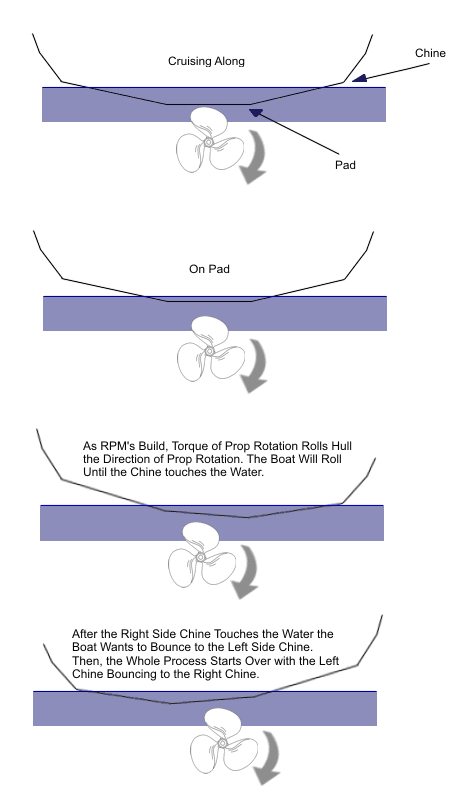
The more V a
pad has, the
faster it
usually is
because there
is less boat
in the water
and thus less
surface
friction. With
that in mind,
it's also
easier for the
torque of the
prop to roll
the boat off
the dead
center of the
pad and start
the chine
walking
process.
We often hear
the term,
"Drive the
Boat" with
regard to
chine walking
without much
explanation as
to what that
is.
This is not
gospel, but
it's what I
think of when
I hear the
term "Drive
the Boat".
There is a
balance
between motor
height with
the jackplate,
trim of the
motor, and how
the driver
handles the
steering
wheel.
Steering to me
is one of the
big tricks.
You will start
to learn your
boat and its
setup and as
you learn you
will know when
the boat is
about to start
chine walking.
As you see in
the diagram,
the rotation
of the prop
pulls the boat
to the right,
the key with
steering is to
counter the
rotation with
small steering
wheel twitches
to the left
before the
chine walking
starts. All of
these things
together are
kind of like
riding a
wheelie on a
bike.
(Click on the
illustration
shown above to
enlarge)
Just a note to say thanks for the prop work on my tempest plus. I finally have the boat I thought I bought.(TR21) I got it to the lake today for a test run. I never knew what people were talking about when they said they had chine walk on a triton. Believe me I do now. I took your advise and raised the prop shaft to 2-1/2" and went from 65mph to 74mph top speed. It might even have gone faster if I stayed on the throttle longer but I can see I need to relearn to drive my boat. The hole shot is also waaaay better than before you did the work. I have already recommended you to about everyone I know that owns a boat.
Thanks again for the great work,
Norman Glenn
What is a custom propeller?
At Steve’s
Custom Props,
propellers are
modified to
perform in
rpm’s, for
what the
customer is
attempting to
obtain.
Pitch changes
and or
progression
changes are
made to obtain
exact top end
rpm’s per
application.
Rake angles
can also be
changed to
obtain higher
bow lift.
Leading edges
can be
modified for
better hole
shots.
Blade
sharpening can
also be done
to help with
an increase in
rpms and
higher top end
mph.
All blades are
matched
exactly in
pitch,
progression,
and rake
angles.
All blades are
highly
polished after
they are
balanced to
perfection.
Exhaust ports
can be
expanded or
welded to
obtain the
correct amount
of exhaust
ventilation
per
application.
See custom
worksheet for
information
needed to have
your prop
“customized”
Call for pricing: 903-763-0200
For Your Prop Requests:
Click
here
for
work
sheet
Simply print the page and fill in
the requested info and bring it into the shop or mail it to:
Steve's
Custom
Props
3734 West State
Highway 154
Yantis, TX 75497
Steve
will
contact
you
with
the
details
for
your
prop
including
pricing.